
Please click on any of the underlined citations to download the following articles. Most of the articles are PDF links so you will need Adobe Reader (free on internet). Some of the dates are out of order because some journals are behind on publishing, but the top-most publications indicates the most recent publication appearing in a journal. The majority of articles below are scientific (peer-reviewed); however, I do include a few popular articles from magazines and websites.
To see my Book Reviews, please click here.
Most recent publications at the top of this list:
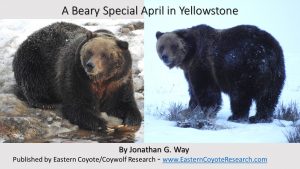
Way, J.G. 2024. A Beary Special April in Yellowstone. Eastern Coyote/Coywolf Research, Barnstable, Massachusetts. 596 pages. E-book. Open Access URL: http://www.easterncoyoteresearch.com/BearySpecialAprilinYellowstone.
Way, J.G. 2024. The Power of Individuals. Maine Wolf Coalition Newsletter. Winter 2024. URL: https://sites.google.com/view/mwc-winter-newsletter-2024/home.
Way, J.G. 2024. Eastern Coyote/Coywolf Ecology and Interactions with Prey. Maine Wolf Coalition Newsletter. Winter 2024. URL: https://sites.google.com/view/mwc-winter-newsletter-2024/home.
Way, J.G. 2023. A Primer on Political Obstruction of Research. Maine Wolf Coalition Newsletter. Summer 2023. URL: https://sites.google.com/view/mwc-summernewsletter2023/home
Glowa, J.M., and J.G. Way. 2023. Wolves are in the Northeast: Will We Adequately Protect Them? Maine Wolf Coalition Newsletter. Spring 2023, pages 4-6. URL: http://mainewolfcoalition.org/wp-content/uploads/2023/04/MWC-Newsletter-Spring-2023.pdf
Way, J.G. 2023. Our unique Canis: the eastern wolf and eastern coyote/coywolf. Maine Wolf Coalition Newsletter. Winter 2023 URL: http://mainewolfcoalition.org/wp-content/uploads/2023/02/MWC-Newsletter-Winter-2023.pdf
Way, J.G. 2022. Backpacking the Iconic Pemigewasset Wilderness. Eastern Coyote/Coywolf Research, Barnstable, Massachusetts. 255 pages. E-book. Open Access URL: http://www.easterncoyoteresearch.com/BackpackingIconicPemigewassetWilderness.
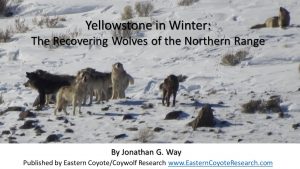
Way, J.G. 2022. Yellowstone in Winter: The Recovering Wolves of the Northern Range. Eastern Coyote/Coywolf Research, Barnstable, Massachusetts. 394 pages. E-book. Open Access URL: http://www.easterncoyoteresearch.com/YellowstoneInWinter.
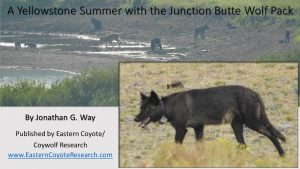
Way, J.G. 2022. A Yellowstone Summer with the Junction Butte Wolf Pack. Eastern Coyote/Coywolf Research, Barnstable, Massachusetts. 481 pages. E-book. Open Access URL: http://www.easterncoyoteresearch.com/YellowstoneSummerWithJunctionButteWolfPack.
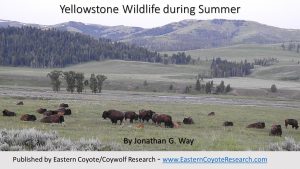
Way, J.G. 2021. Yellowstone Wildlife during Summer. Eastern Coyote/Coywolf Research, Barnstable, Massachusetts. 467 pages. E-book. Open Access URL: http://www.easterncoyoteresearch.com/YellowstoneWildlifeDuringSummer. This is a comprehensive book on about 10 summers of travel to Yellowstone.
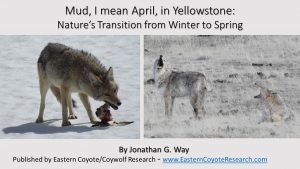
Way, J.G. 2021. Mud, I mean April, in Yellowstone: Nature’s Transition from Winter to Spring. Eastern Coyote/Coywolf Research, Barnstable, Massachusetts. 330 pages. E-book. Open Access URL: http://www.easterncoyoteresearch.com/MudIMeanAprilInYellowstone.
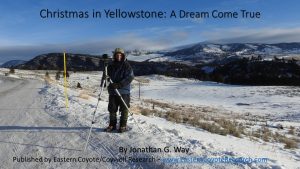
Way, J.G. 2021. Christmas in Yellowstone: A Dream Come True. Eastern Coyote/Coywolf Research, Barnstable, MA. 208 pages. E-book. Open Access URL: http://www.easterncoyoteresearch.com/ChristmasInYellowstone.
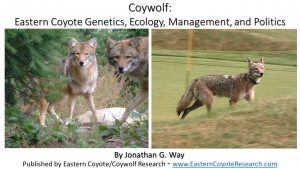
Way, J.G. 2021. Coywolf: Eastern Coyote Genetics, Ecology, Management, and Politics. Eastern Coyote/Coywolf Research, Barnstable, MA. 277 pages. E-book. Open Access URL: http://www.easterncoyoteresearch.com/CoywolfBook/. This book is the culmination of the last 20 years of me studying this incredible animal.
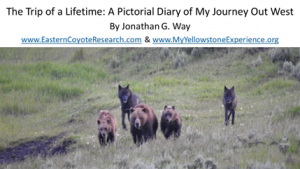
Way, J.G. 2020 (Revised, 2021). The Trip of a Lifetime: A Pictorial Diary of My Journey Out West. Eastern Coyote/Coywolf Research, Barnstable, MA. 561 pages. E-book. Open Access URL: http://www.easterncoyoteresearch.com/thetripofalifetime/. This adventure story is the result of a dream month-long trip I took during summer 2019 visiting many western national parks. It includes nearly 1,000 pictures in the 561 page volume!
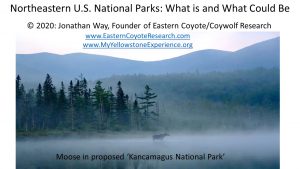
Way, J.G. 2020 (Revised, 2021). Northeastern U.S. National Parks: What Is and What Could Be. Eastern Coyote/Coywolf Research. 268 pages. E-book. Open Access URL: http://www.easterncoyoteresearch.com/northeasternusnationalparks/. This book makes the case to expand the National Park (NP) System in the Northeast, beyond just having Acadia National Park as its only large “natural” park, by adding 3 units: Cape Cod NP, Kancamagus NP in NH, and Maine Woods NP and Preserve. It includes over 500 pictures.
Way, J., and L. Kane. 2019. Reforming carnivore management: Proposed Draft Language of the Carnivore Conservation Act of Massachusetts with Testimonials of Support. 6 pages. URL: http://www.easterncoyoteresearch.com/downloads/ReformingCarnivoreManagementTestimonials.pdf. This letter summarizes the Carnivore Conservation Act (2014) into 1 page and provides 5 pages of professional Testimonials in support of this act. It can be used when reaching out to legislators to reform carnivore management.
Way, J.G., and J.L. Hirten. 2019. Wild Canis spp. of North America: a pictorial representation. Canadian Field-Naturalist 133: 295-296. This short article is a continued look at the uniqueness of the eastern coyote/coywolf and how it relates to other canids (coyotes and wolves) in North America.
Jackman, J. L., and J. G. Way. 2018. Once I found out: Awareness of and attitudes toward coyote hunting policies in Massachusetts. Human Dimensions of Wildlife 23(2): 187-195. DOI: 10.1080/10871209.2017.1397824. This is an exciting new paper that shows the general public’s distaste for carnivore hunting and how they are overwhelming opposed to hunting practices on coyotes. I am sure that future research will verify this in most of the U.S. Will state wildlife agencies acknowledge this and guide future management to how the public wishes, or will they remain special interest focused on satisfying the small minority of people that hunt carnivores?
Carlesco, A., J.G. Way, and L. Kane. 2017. Complaint about information quality: Use of the Connolly and Longhurst (1975) paper in justifying coyote control. 23 pages. URL: https://www.peer.org/assets/docs/usda/12_20_17_PEER_DQA_Complaint.pdf. This document (and see the press release here) challenges an old study that will no doubt start to legally reform carnivore management nationwide. We were able to get a lot of major people/scientists to sign on to this including Jane Goodall! It is the beginning of a new era of challenging special interest dominated flawed wildlife (specifically carnivore) management and this document will be used to challenge carnivore hunting and control programs in the very near future.
Way, J.G. and Lynn, W.S. 2016. Northeastern coyote/coywolf taxonomy and admixture: A meta-analysis. Canid Biology & Conservation 19(1): 1-7. URL: http://canids.org/CBC/19/Northeastern_coyote_taxonomy.pdf. This paper summarizes the literature and suggests that not only should ‘coyotes’ in the Northeast be called coywolves, but that they warrant new species status, Canis oriens – meaning eastern canid!
Way, J. G. 2016. Blackballed by the Massachusetts Division of Fisheries and Wildlife: Research Obstruction Testimonial by an Independent Eastern Coyote/Coywolf Biologist. Eastern Coyote Research Publications 5: 1-15. URL: http://easterncoyoteresearch.com/downloads/ResearchObstructionTestimonialSept2016.pdf. This document is fairly self-explanatory in how the state has obstructed my research. It is now a separate page on my website: http://easterncoyoteresearch.com/ResearchObstructionTestimonial. Please contact the Governor of Massachusetts to voice your opinion.
Way, J.G. 2016. Why the eastern coyote should be a separate species: the ‘coywolf’. The Conversation. 11 May. URL: https://theconversation.com/why-the-eastern-coyote-should-be-a-separate-species-the-coywolf-59214. This paper explains why I believe the eastern coyote should be called coywolf, Canis oriens. It is written in the academic journal The Conversation to explain, in layman’s language, the findings of the Way and Lynn 2016 article (above).
Way, J. G. 2016. Coywolf: A new species in our midst? International Wolf 26(3, fall): 28-29. Please note that there is an error on the first page and the canid to the right should say western not eastern coyote. Otherwise it is a nice account, in layman’s language, of the uniqueness of the eastern coyote or coywolf.
Way, J.G. 2014. Strategies for red wolf recovery and management. Canid Biology & Conservation. 17(2): 9-15. URL: http://www.canids.org/CBC/17/Red_wolf_recovery.pdf. In this paper, I offer avenues to improve red wolf recovery and, importantly, offer 8 strategies many of which include revising state agency management of carnivores, specifically canids.
Bruskotter J.T., A. Treves, J.G. Way. 2014. Carnivore Management. Pages 83-90 in B.S. Steel (editor). Science and Politics: An A-To-Z Guide to Issues and Controversies. CQ Press, Thousand Oaks, CA, USA. Update Feb. 2015: PDF not available.
Kane, L., and J.G. Way. 2014. Carnivore Conservation Act of Massachusetts. Revised version June 2014 (original version July 2013). 21 pages. URL: http://www.EasternCoyoteResearch.com/downloads/MACarnivoreConservationActJune2014.pdf. The CC Act was revised June 2014 to include a “Carnivore Conservation Stamp” for non-hunters and wildlife watchers to be able to purchase (section 3.d) and it defines where the funds for 3.d (carnivore stamp) and 3.c (Carnivore Hunting Tag) are dedicated. Secondly, we add an important term in section 3.f called “harvest threshold” that is aimed at preserving the natural social organization and population stability of each carnivore species. Lastly, we revised 3.i to make the act more palatable and fair for farmers. We really like the additions to this version as it allows non-hunters to put their money where their mouths are to help support carnivore conservation and assist livestock and pet owners with preventing depredations.
Way, J.G. 2013. Taxonomic Implications of Morphological and Genetic Differences in Northeastern Coyotes (Coywolves) (Canis latrans × C. lycaon), Western Coyotes (C. latrans), and Eastern Wolves (C. lycaon or C. lupus lycaon). Canadian Field-Naturalist 127(1): 1–16. This is an important scientific paper suggesting that the eastern coyote should more appropriately be called “coywolf” given their mixed species ancestry and intermediate morphological and genetic status.
Kane, L., and J. G. Way. 2013. Petition to create a Carnivore Conservation Act in Massachusetts. 20 pages. URL: http://www.EasternCoyoteResearch.com/downloads/MACarnivoreConservationActJuly2013.pdf. This is a major event. I believe that Louise and I crafted North America’s first Carnivore Conservation Act. While this is intended for MA, we hope that it is eventually made into a national act, similar to how Raptors and Eagles are protected by special legislation. We are in the early stages and need help with legislators and other people to get the ball rolling on this.
Way, J.G., and B.N. White. 2013. Coyotes, red foxes, and the prevalence of Lyme disease. Northeastern Naturalist 20(4):655-665. This paper questions the findings from a paper authored by Levi et al. (2012). Here, we make the case that coyotes may indeed be an agent that can help reduce Lyme disease similar to what is claimed for red foxes.
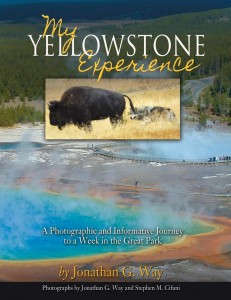
Way, J. G. 2013. My Yellowstone Experience: A Photographic and Informative Journey to a Week in the Great Park. Eastern Coyote Research, Cape Cod, Massachusetts. 152 pages. This is my second full-length book following Suburban Howls. MYE is 152 pages with 306 pictures printed in full color on glossy paper.
Way, J.G. 2012. Eastern coyote/coywolf life cycle in southeastern Massachusetts and some commonly asked questions. Eastern Coyote Research Publications 4: 1−5. URL: http://easterncoyoteresearch.com/downloads/EasternCoyoteLifeCycle.pdf. This paper answers many questions that I have been asked over the years and does so in a paper that can be referenced. It includes an often asked question: “How many coyotes are there?” I updated the paper June 2013.
Way, J. G. 2012. Love wolves and hate coyotes? A conundrum for canid enthusiasts. International Wolf 22(4, winter): 8-11. A popular (not peer reviewed) article summarizing my (and others’) feelings on why society treats wolves so much differently than coyotes.
Way, J.G., and J.T. Bruskotter. 2012. Additional Considerations for Gray Wolf Management after their Removal from Endangered Species Act Protections. Journal of Wildlife Management. 76(3): 457-461. Note: this is my first publication with this respected scientific journal, as well as my first on the coywolf’s large cousin, Canis lupus. The theme of the article is very similar to the opinions that are expressed on the Management Recommendations section of this webpage.
Way, J.G. 2012. Seasonal and Study Site variation in Box-trapping Eastern Coyotes. Canid News. 15.2: 1-5. URL: http://canids.org/canidnews/15/Box-trapping_eastern_coyotes.pdf. Note: this is my 2nd scientific paper on box trapping “coyotes” despite the fact that people still say it can’t be done!
Way, J.G. 2011. Eastern Coyote/Coywolf (Canis latrans x lycaon) Movement Patterns: Lessons Learned in Urbanized Ecosystems. Cities and the Environment (CATE) 4(1): article 2, 12 pages. http://digitalcommons.lmu.edu/cgi/viewcontent.cgi?article=1044&context=cate. This important peer-reviewed paper summarized much of my research from the previous 10+ years, and gives a perspective of eastern coyote/coywolf ecology, focusing on movement patterns.
Way, J.G., and B. Timm. 2011. Record Pack-density of Eastern Coyotes/Coywolves (Canis latrans x lycaon). American Midland Naturalist 165(1):201-203. Note: This is my first publication with this long-standing journal. It documents a pack living at a very high density in an urban area.
Way, J.G. 2010. Double-litters in Coywolf (Canis latrans x lycaon) Packs Following the Death or Disappearance of a Resident Territorial Male. Canadian Field Naturalist 124(3): 256-257. The utility of allowing people to kill coyotes and coywolves is becoming increasingly questioned. This paper piggie-backs on the “Pack Density Doubling after Death of a Male” paper to show that it isn’t so simple as to kill coyotes/coywolves and reduce their populations. In fact, I am convinced that leaving coyotes and coywolves alone will eventually allow them to settle into a lower density, more stable population composed of older animals that cause fewer problems with people and have large territories that they keep other coyotes/coywolves out of. Hopefully, one day state fish and game departments will recognized this and will appropriately revise their hunting regulations to better protect predators by not allowing people to needlessly kill social, intelligent animals essentially for fun.
Connare, C. 2010 (Fall). Pack Mentality: Can we live peacefully with coywolves among us?. UMass Amherst Magazine 5(1): 35-38. http://viewer.zmags.com/publication/9db7ca7c#/9db7ca7c/37. A nice article on my work from my alma mater about my attempt to make this research a long-term study.
Way, J.G., L. Rutledge, T. Wheeldon, B.N. White. 2010. Genetic characterization of Eastern “Coyotes” in eastern Massachusetts. Northeastern Naturalist. 17(2): 189-204. Here is the published version of our paper which recommends that the Eastern Coyote now be called Coywolves due to their mixed heritage from Coyotes and Red/Eastern Wolves. I believe it is not appropriate to call them Coyotes because at least 1/3 of their background is from wolves, and 2/3 of their background does not seem to derive from Western Coyotes (> 1/3 of mtDNA haplotypes relates to Coyotes but is only found in Eastern Wolves and Coywolves, not Western Coyotes).
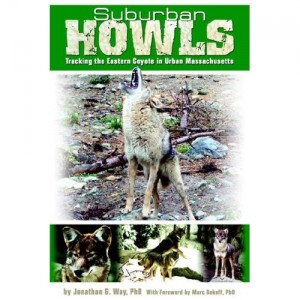
McBride, B. 2009. Book Review – Suburban Howls: Tracking the Eastern Coyote in Massachusetts. Canadian Field Naturalist 123: 83. A nice review of my book, Suburban Howls.
Way, J. G., B. C. Timm, and E. G. Strauss. 2009. Coywolf (Canis latrans x lycaon) Pack Density Doubles Following the Death of a Resident Territorial Male. Canadian Field Naturalist 123(3): 199-205. Note: this is a major finding. This paper scientifically documents the killing of a breeding male Coywolf and the subsequent increase in density from his original territory. Many people don’t believe the claim that killing coyotes/coywolves can increase a local population but life isn’t so simple as kill one and reduce the population.
Way, J. G. 2009. Standing-Over in captive Coywolves (Canis latrans x lycaon). Canadian Field Naturalist 123(3): 262-264. This paper illustrates another advantage of captive studies; you just don’t see this type of behavior in the wild, and if so, it is very uncommon. Previously, only Dr. Dave Mech has quantified this behavior with Gray Wolves in the High Arctic.
Way, J. G. 2009. Observations of Coywolves, Canis latrans x lycaon, Crossing Bridges and Using Human Structures on Cape Cod, Massachusetts. Canadian Field-Naturalist 123(3): 206-209. This paper provides important documentation of the use of human structures by coyotes and how they might just associated these things (bridges, buildings) as just another part of their territory similar to more wooded areas of their range.
Way, J.G. 2009. Incidental captures of American Crows in coyote-sized box traps. Journal of Field Ornithology 80(4): 433-437. Coywolves are not the only creatures that like bait! Crows are supposed to be very difficult to catch but I have captured over 150 in box traps.
Way, J. G., and R. D. Cabral. 2009. Effects of Hierarchy Rank on Caching Frequency in a Captive Coywolf (Eastern Coyote), Canis latrans x lycaon, Pack. Canadian Field Naturalist 123(2): 173-175. The importance of captive studies is illustrated here as this finding would be nearly impossible to document in the wild.
Glowa, J., W. L. Pepperman, C. L. Schadler, J. Butera, and J. G. Way. 2009. Petition submitted to protect wolves and allow wolf recovery in the northeast. Submitted to U.S. Department of Interior on 31 January 2009. 17 pages. This paper seeks to give the eastern coyote or coywolf more legal protection since people who shoot and kill a full-bodied wolf (gray or eastern) literally get a slap on the wrist when they say, “I thought I was killing a coyote.” They are really committing a crime when they kill a wolf. Update 19 June 2010: We finally have news: the service rejected our request (what a surprise) to list the Gray Wolf as a Distinct Population Unit in the Northeast but 2 things remain possible: (1) we can appeal the finding and a judge is more likely to meet our demands than state and federal wildlife agencies, and (2) there still is a chance to list the Coywolf (called Coyotes by the service) under the Endangered Species Act to better protect Wolves naturally returning to the Northeast. Read letter here.
Way, J.G. 2009. How does a curriculum intervention that anchors instruction to the study of urban coyote behavior affect student learning? Electronic Journal of Science Education 13(1): 1-31. http://ejse.southwestern.edu/article/viewFile/7784/5551. This paper shows some of the ways that you can utilize local wildlife species to educate students.
Way, J. G., T. Higginbotham, D-L. Szumylo, and E. G. Strauss. 2009. Factors affecting eastern coyote activity levels in captivity. Canid News 12.4: 1-11. URL: http://www.canids.org/canidnews/12/Captive_coyote_activity_levels.pdf. Note: this is another publication related to the captive eastern coyote study that I did. This type of paper is just about impossible to do on wild coyotes.
Way, J. G. 2009. Assessing White-tailed Deer Abundance in the Town of Barnstable, Cape Cod, Massachusetts. Eastern Coyote Research Publications 1: 1-11. URL: http://easterncoyoteresearch.com/downloads/DeerAbundanceTownBarnstableJWay.pdf. This paper details how deer are much less abundant on the mid-Cape than in most places on the East Coast. As I have said before, I honestly see more wolves in Yellowstone in the 1 week a year (on average) that I visit the park compared to an entire year looking for deer (and of course coywolves) on Cape Cod where I am frequently active at dawn/dusk and at night.
Russo, C. 2008. The eastern coyote: One man’s life work. Wildlife Conservation. 111(1): 52-53. Please note: this article is a non-peer reviewed, non-scientific article. Rather it is a popular article on my research and appeared in this internationally known wildlife magazine!
Way, J. G., and B. C. Timm. 2008. Nomadic Behavior of an Old and Formerly Territorial Eastern Coyote, Canis latrans. Canadian Field-Naturalist 122(4): 316-322. This scientific peer-reviewed paper shows the importance of individuals. Wildlife agencies unfortunately focus on populations, but obviously individuals form the core of populations and some individuals are particularly important to a system (and to people that watch them).
Way, J. G. 2008. Eastern Coyotes, Canis latrans, Observed Feeding on Periodical Cicadas, Magicicada septendecim. Canadian Field-Naturalist 122(3): 271-272. This article illustrates just how adaptable these animals are. They were observed feeding on prey that had not been available for the past 17 years!
Way, J. G. 2008. Eastern Coyote: Coyote, Wolf, or Hybrid? International Wolf 18(3): 7-10. Note: this publication is from the International Wolf Center (www.wolf.org) which is an educational center in Ely, Minnesota. My dream and goal is to create an Eastern Coyote Discovery Center on Cape Cod which mimics the wolf center’s format. You can also view the article from their online magazine here.
Way, J. G. 2007. A comparison of body mass of Canis latrans (Coyotes) between eastern and western North America. Northeastern Naturalist 14(1):111-124. This is the first of my taxonomy related papers. This paper – a prelude to the genetic research in 2010 and 2013 (see papers above) – conclusively shows that northeastern coyotes are the biggest type of coyotes in North America.
Way, J. G. 2007. Suburban Howls: Tracking the Eastern Coyote in Urban Massachusetts. Dog Ear Publishing, Indianapolis, Indiana, USA. 338 pages. Buy here.
Way, J.G. 2007. Letter on Proposed Coyote Management in Massachusetts. Eastern Coyote Research Publications 3: 1-4. URL: http://easterncoyoteresearch.com/downloads/CoyoteManagementLetterToState2007ShortVersion.pdf. Note: This is my official letter voicing my strong disagreement with increasing the “coyote” hunting season back in 2007. My caution was ignored and the minority of hunters that hunt coyotes won – perhaps not surprisingly as many people (including myself) thought the public meetings were just for show. That is, even if 80% were against the extension, it was going to happen anyway. I hope a ballot initiative down the road changes this.
Way, J. G. 2007. Social and Play Behavior in a Wild Eastern Coyote, Canis latrans, pack. Canadian Field-Naturalist 121(4): 397-401. Note: this paper scientifically details the playful, sentient side of eastern coyotes.
Way, J. G. 2007. Movements of Transient Coyotes, Canis latrans, in Urbanized Eastern Massachusetts. Canadian Field-Naturalist 121(4): 364-369. This paper shows how transients move long distances, even in urbanized locales.
Way, J.G. 2006. Creating a Wildlife Watching Area in the town of Barnstable. Eastern Coyote Research Publications 2: 1-18. URL: http://easterncoyoteresearch.com/downloads/BarnstableCoyoteDeerMgmt.pdf. Note: This is a paper detailing my push for a wildlife watching area on Cape Cod, similar to our many national parks out west. The letter has been ignored or denied by Mass Wildlife and the Town of Barnstable.
Way, J. G. 2005. Assessing student learning and interest in eastern coyotes. Dissertation, Boston College. 285 pages.
Introductory pages (10 pages)
Body of Dissertation (285 pages)
Way, J. G. 2002. Radio-collared coyote crosses Cape Cod Canal. Northeast Wildlife 57: 63-65.
Way, J. G. 2001. The eastern coyote: documenting the habits of one of Cape Cod’s newest residents. Conservation Perspectives, the online journal of the New England Chapter of the Society for Conservation Biology. http://www.nescb.org/epublications/spring2001/coyotes.html. This article is not currently available online so I scanned the article into a color pdf (click here)


